Property Management
Top 6 Auckland property management companies
Find out who the top 6 property managers in Auckland are, and why we think they make the cut.
Property Management
8 min read


Author: Ed McKnight
Resident Economist, with a GradDipEcon and over five years at Opes Partners, is a trusted contributor to NZ Property Investor, Informed Investor, Stuff, Business Desk, and OneRoof.
Reviewed by: Tiffany Bracey
Property Manager Team Leader at Opes Property Management Auckland.
As a property investor you don’t need to rely on your property manager to tell you what the market rent of your property should be.
You can figure out how much your rent should (or could) be all by yourself.
In this case study, you’ll see the exact research I did to figure out that my 2-bed apartment in Christchurch was woefully under-rented at only $405 per week – and that the market rent is around $460 per week.
In this article, you’ll learn the 4-step process I used, so you can use the same for your investment properties.
Do you have a question or comment about the market rent? Feel free to leave your thoughts in the comment section at the end of the page.
According to Tenancy Services – “Market rent is the amount a landlord might reasonably expect to receive, and a tenant might reasonably expect to pay, for a tenancy.”
OK, that’s a lot of jargon. What does that actually mean?
Basically, the “market rent” means that two similar properties in the same area should roughly charge the same amount of rent.
This is determined by what tenants – in general – are willing to pay, and what landlords are willing to rent their properties out for.
This means the rent isn’t just “chosen” by the landlord (you can’t just pick any rent amount you want to).
For instance, if a landlord decides he wants to charge an amount significantly higher than the market rent, a tenant can ask for the rent to be reduced through the Tribunal.
If you want to find out what the market rent is in your property’s area, you can type your address into the Market Rent Tool to get an idea.
| House size | Market rent |
|---|---|
| 2-bedroom | $600 |
| 3-bedroom | $670 |
| 4-bedroom | $800 |
Tenancy Services (January 2026).
That is why you should compare your property with homes that have the same number of bedrooms. Comparing a 2-bedroom unit with a 4-bedroom family home will give you the wrong benchmark. So, you won’t calculate the market rent the right way.
Property type matters too. Houses, apartments, and flats will all get different rents, even in the same suburb.
Again, using Avondale as an example, the current median rent for a 2-bedroom property changes depending on the type.
The median 2-bedroom apartment rents for $30 more than the equivalent flat.
And the median 2-bedroom house rents for $50 more than the equivalent apartment.
| Property type | Median rent for 2-bedroom property |
|---|---|
| Apartment | $550 |
| Flat | $520 |
| House | $600 |
Tenancy Services (January 2026).
So, if you own a 2-bedroom apartment, compare it with other 2-bedroom apartments, not 2-bedroom houses.
Once you’ve matched the location, bedroom count, and property type, a few secondary factors can still move the rent up or down:
Here’s a step-by-step guide to working out what the market rent is in your property’s area.
For this, I’ll use a property I own in Central Christchurch as an example. It’s a 2-bed, 1-bath apartment with two car parks.
At the time the rent was $480 a week, and the rent hadn’t changed for 2 years. So, I wanted to calculate the market rent. Here’s the exact process I used.
A good place to start your investigations is with the Trade Me Rental Price Index.
This will show you if market rents have gone up or down over the past 12 months.
For example, according to the Trade Me Rental Price Index:
Rents in Canterbury are down -0.9% from Jan 2025 - Jan 2026.
The average rent in Christchurch was $575 a week as of January 2026.
Another option is to use Area Analyser, a free tool from Opes Partners that lets investors get free data about any area in the country.
This uses different data (sourced from Tenancy Services) and shows that the median rent in Christchurch was $575 a week in January 2026. That’s up $15 a week (2.6%) year-on-year.
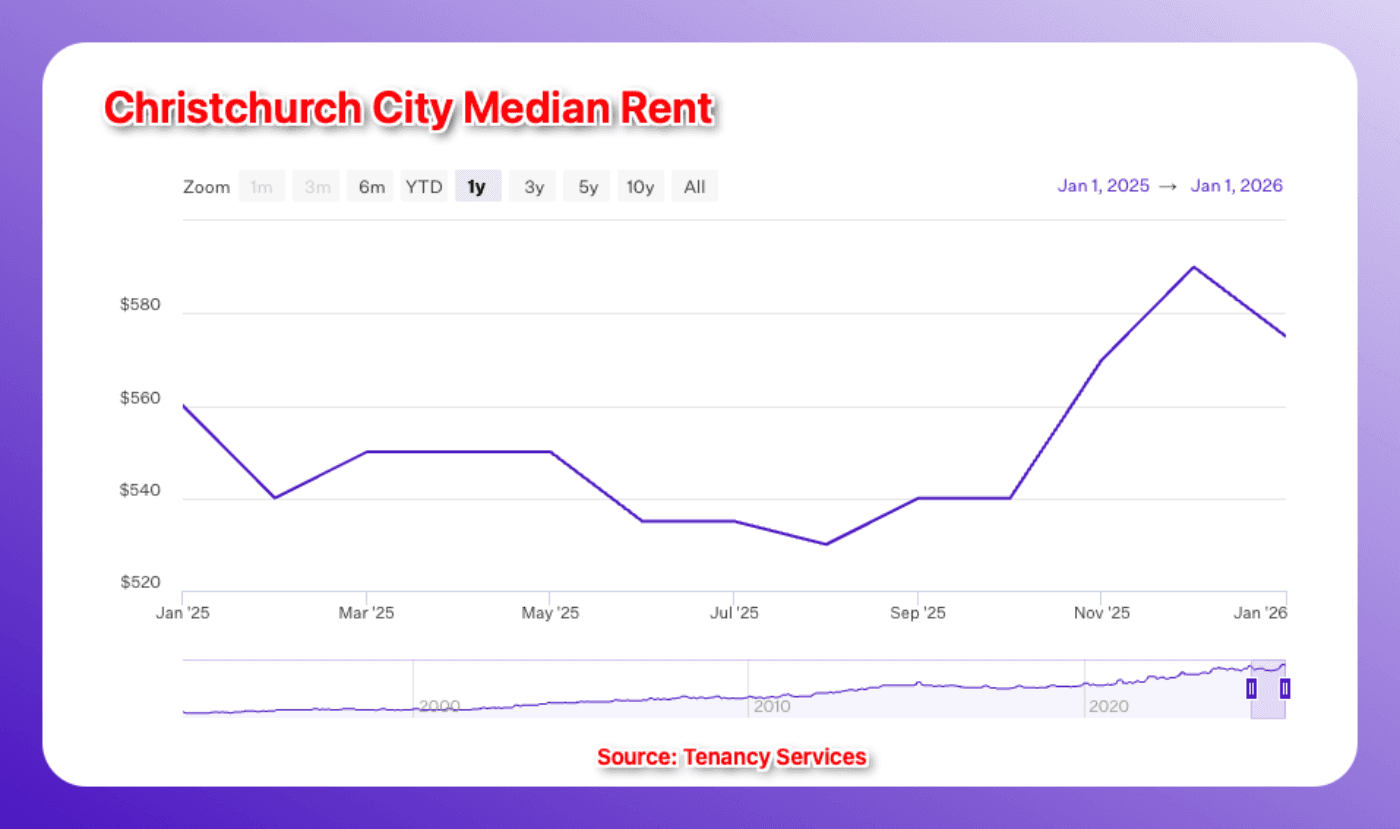
So, these 2 sources suggest the Christchurch rental market has only subtly changed over the last year.
If my property had followed the market (i.e. somewhere between -0.9% to +2.6%) then the market rent for my property might either be:
But that only works if your property was already at the market rent, and if the rent hadn’t changed in a year. And since my property’s rent hadn’t moved in 2 years, I felt it was already under-rented.
The next step in the process is to use the Tenancy Services Market Rent tool.
This shows what the median property rented for over the last 6 months.
Handily, this is often broken down by property type (e.g. townhouse vs apartment) and the number of bedrooms.
For my property, Tenancy Services says the median rent for a 2-bedroom apartment in Central Christchurch is $540. It also says that properties rent for between $485 (at the lowest) and $595 (at the highest).
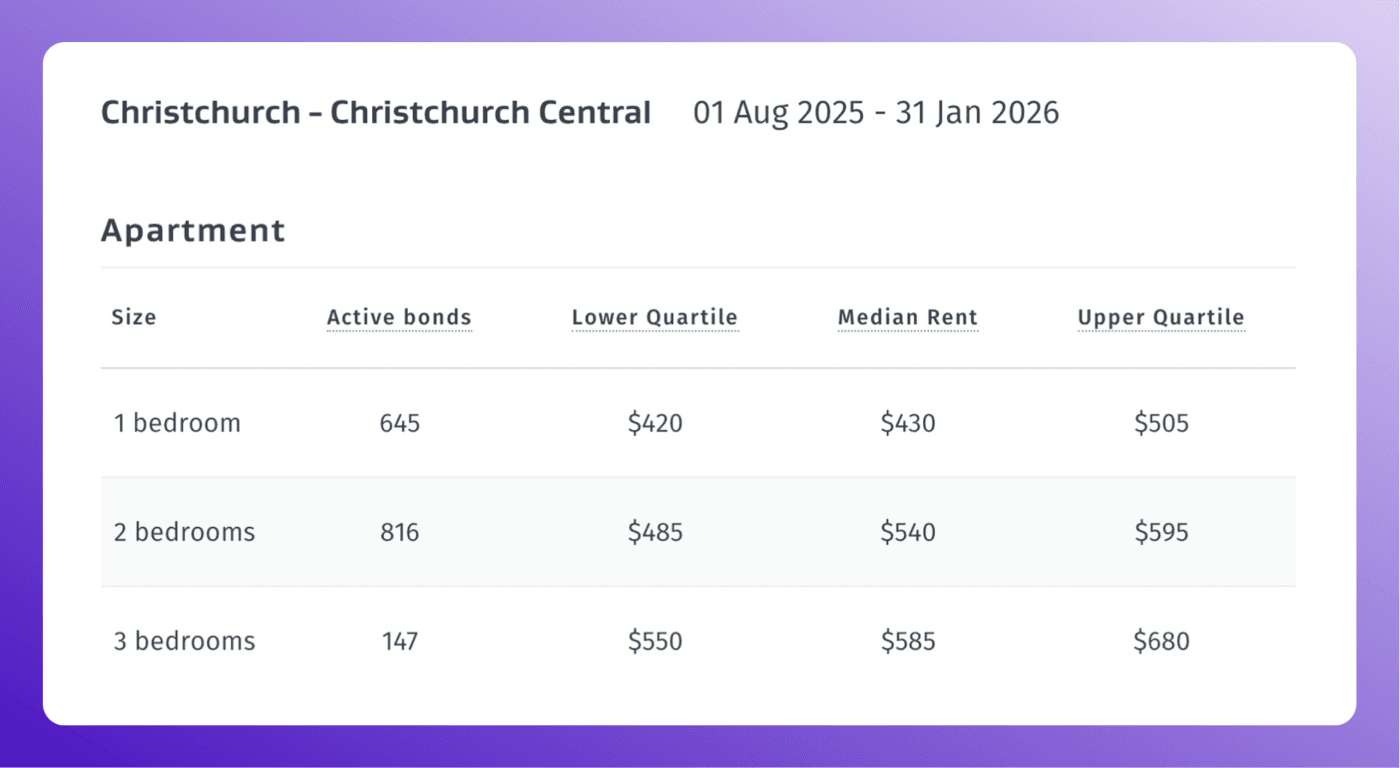
This tells me that my property’s rent was likely too low. It was renting in the bottom 25% of properties. But, since the property was only renovated 7 years ago, I expect it would rent around the average.
So, looking at the Tenancy Services data can be more useful than simply looking at if rents have gone up or down over the last year. Because you might find that your property was under-rented from the beginning.
Just keep in mind that Tenancy Services only breaks down suburbs by property type and bedrooms when there is enough data. So, this granular data is often available for larger cities, but not tiny towns.
This is the final and most important step.
You’ve got to compare your property with similar ones available for rent on Trade Me and realestate.co.nz.
I’m not talking about a cursory glance. Instead, you should take the same structured approach that a valuer does when looking at your property.
Go to Trade Me and look at a handful of similar properties. You then assess if your property is better or worse. If your property is better, then the market rent will be higher than those properties.
If your property is worse, then the market rent for your property will be lower than those properties you see online.
Here’s the exact process I used for my property.
At the time, there were 29 x 2-bed apartments for rent in Christchurch. But I only picked 6 of them to analyse for my research table.
I considered what was on offer, the photos, and the area. Then I ranked them in terms of whether they were superior (better) or inferior (worse) to my property.
| Listing | Rent | Beds | Baths | Car parks | Inferior / superior to my property | Justification |
| 104/177 Cashel Street | $500 pw | 2 | 1 | 1 | Inferior | Same bedroom and bathroom count, but only 1 off-street car park compared with my 2 separate car parks. |
| 7/232 Armagh Street | $700 pw | 2 | 1 | 1 | Superior | Same bed/bath count, and 1 less carpark. But this one is fully furnished and is higher-spec. |
| 253 Hereford Street | $710 pw | 2 | 1 | 1 | Superior | Same bed/bath count but this is a partly furnished penthouse-style apartment with a more premium positioning. |
| 63/868 Colombo Street | $480 pw | 2 | 1 | 1 | Inferior | Same bed/bath count, but only 1 underground car park. It is also unfurnished, and the photos suggest the apartment is more dated. |
| 3/36D Welles Street | $600 pw | 2 | 1 | 1 | Superior | Same bed/bath count, with 1 less car park. However, this one is fully furnished with added extras like lock-up storage. |
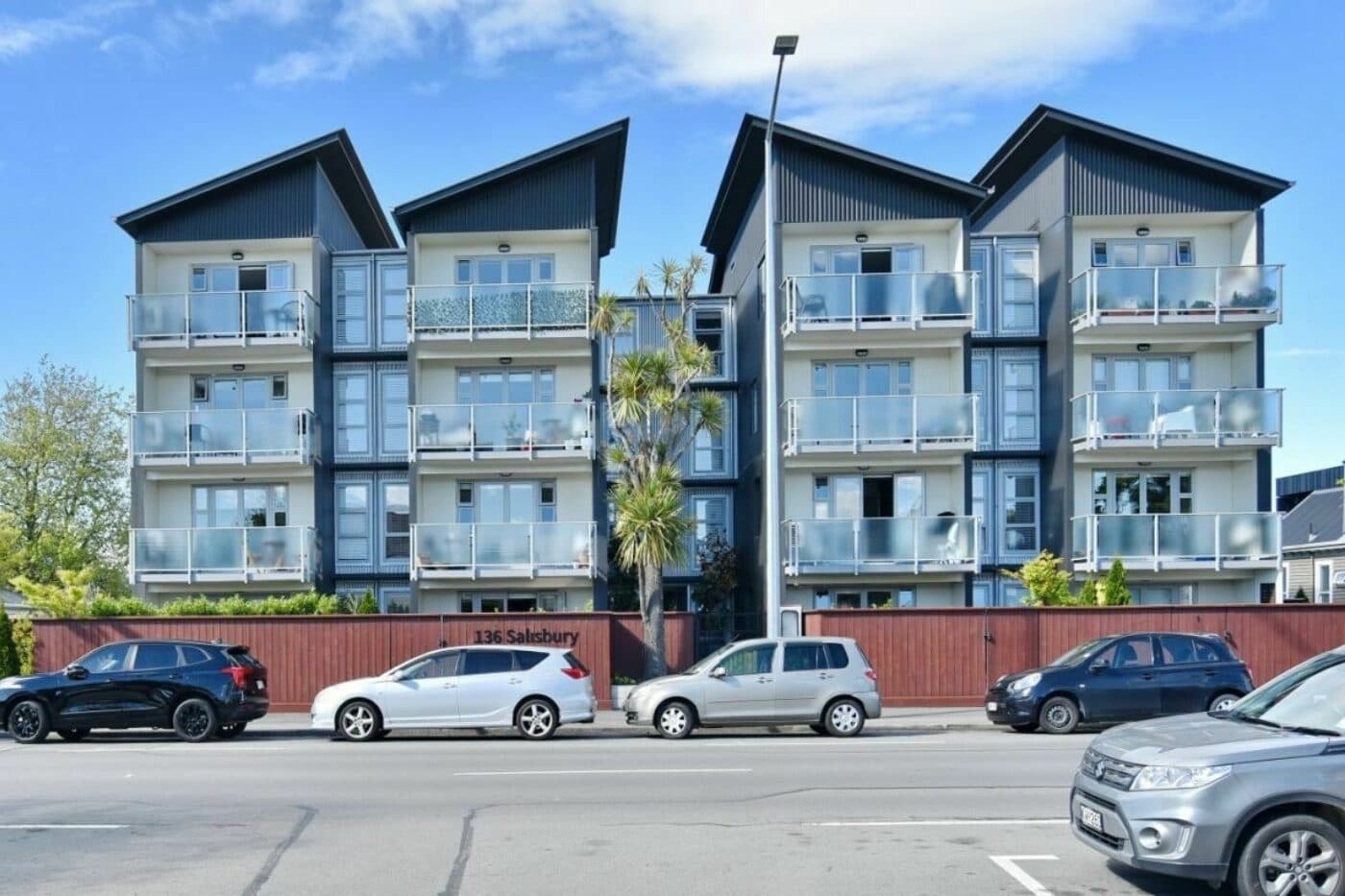
| 31/136 Salisbury Street | $530 pw | 2 | 1 | 1 | Comparable | This is the closest match to mine: same 2 bedrooms, 1 bathroom, and importantly 2 off-street car parks. |
This method strips away the emotion that can come with rent rises. And means you can base your decision on data.
This table suggests a few things:
So my sense is that the market rent sits between $520 and $540 a week.
Going through this process we learned:
For me, $520 feels right. It increases the rent to market level.
And if my tenant decides to move out after their fixed-term contract ends, I can likely get another tenant for $530 a week.
It’s a big rent increase from what it was, but given that it was under-rented I feel confident that it’s a fair increase.
I get it. This takes a bit of time.
But if you only do it once a year, it should take about an hour. And it means you can set the rent with confidence, rather than guessing or going with your gut.
It also gives you evidence to back up your decision.
At the end of the day, the goal is not to guess the rent. It’s to use the evidence in front of you to work out what the market will realistically pay.
Do that well, and you’re much more likely to set a rent that is fair to the tenant and to you as the landlord ... and it's easy to defend if it’s ever challenged.
Resident Economist, with a GradDipEcon and over five years at Opes Partners, is a trusted contributor to NZ Property Investor, Informed Investor, Stuff, Business Desk, and OneRoof.
Ed, our Resident Economist, is equipped with a GradDipEcon, a GradCertStratMgmt, BMus, and over five years of experience as Opes Partners' economist. His expertise in economics has led him to contribute articles to reputable publications like NZ Property Investor, Informed Investor, OneRoof, Stuff, and Business Desk. You might have also seen him share his insights on television programs such as The Project and Breakfast.
This article is for your general information. It’s not financial advice. See here for details about our Financial Advice Provider Disclosure. So Opes isn’t telling you what to do with your own money.
We’ve made every effort to make sure the information is accurate. But we occasionally get the odd fact wrong. Make sure you do your own research or talk to a financial adviser before making any investment decisions.
You might like to use us or another financial adviser